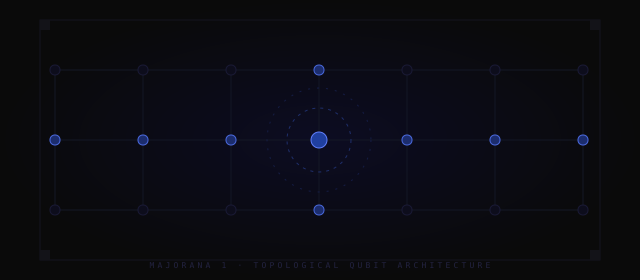
In February 2025, Microsoft announced the Majorana 1, the world's first quantum processor built on a topological architecture. It is not the most powerful quantum computer ever announced. But it may be the most consequential step toward one that can break encryption. Here is why.
A different kind of qubit
Every quantum computer today, from IBM's superconducting systems to Google's Sycamore and Willow chips, relies on physical qubits that are inherently fragile. A stray electromagnetic field, a small temperature fluctuation, or even a cosmic ray can cause a qubit to flip or lose its quantum state. This "decoherence" is the central engineering challenge of quantum computing. To compensate, modern systems use quantum error correction: multiple physical qubits working together to encode a single logical qubit reliably. The overhead is enormous. Running Shor's algorithm against RSA-2048 is estimated to require roughly 4,000 logical qubits, but each logical qubit may need between 1,000 and 10,000 physical qubits for fault-tolerant operation. That is anywhere from 4 million to 40 million physical qubits, far beyond today's systems.
Microsoft's topological approach targets this overhead directly. Rather than fighting decoherence with redundancy, topological qubits are designed to avoid it structurally. They store quantum information non-locally, distributed across the entire quantum state rather than concentrated in a single physical location. This makes them inherently resistant to local disturbances, because there is no single point where a stray field or thermal fluctuation can corrupt the information.
The Majorana zero mode
The physics underlying Majorana 1 involves Majorana zero modes, exotic quantum states predicted by Italian physicist Ettore Majorana in 1937. These particles are their own antiparticle, which gives them a unique topological property: information encoded in them cannot be easily destroyed by local perturbations. Microsoft has spent more than a decade searching for a way to reliably create and control these states. Majorana 1 represents their first publicly demonstrated success.
The chip uses a material Microsoft calls a "topoconductor", a compound of indium arsenide and aluminium that, under specific conditions, forms an interface where Majorana zero modes emerge. The chip integrates eight topological qubits, a modest number, but one that Microsoft describes as a proof of principle for a scalable architecture. Their stated roadmap targets a million-qubit system on a single chip.
What this means for the Q-Day timeline
The standard estimate for a cryptographically relevant quantum computer, one that can run Shor's algorithm against RSA-2048 in a useful timeframe, assumes the current physical-to-logical qubit overhead. If Microsoft's topological approach can reduce that ratio by even a factor of ten, the physical qubit threshold drops from tens of millions to perhaps a few million. That is still an enormous engineering challenge. But it is a fundamentally different order of magnitude.
Three recent papers (published between May 2025 and March 2026) have already cut the theoretical qubit estimate for breaking RSA-2048 by a factor of twenty, using more efficient implementations of Shor's algorithm. Combine improved algorithms with a fundamentally more efficient qubit architecture, and the Q-Day timeline, already revised toward 2029 by several major institutions, may compress further.
Microsoft has not claimed Majorana 1 itself poses any cryptographic threat. Eight topological qubits cannot break anything. But the architecture it demonstrates, if it scales as Microsoft projects, represents one of the more credible pathways to the millions of stable qubits that would.
What organizations should do now
Majorana 1 is not a reason to panic. It is a reason to accelerate planning that should already be underway. NIST finalized its first post-quantum cryptography standards in 2024. The transition to quantum-resistant encryption takes years of planning, procurement, and migration, and that clock is running regardless of which hardware approach ultimately reaches cryptographic relevance first. The organizations most at risk are those that have not yet begun their cryptographic inventory.