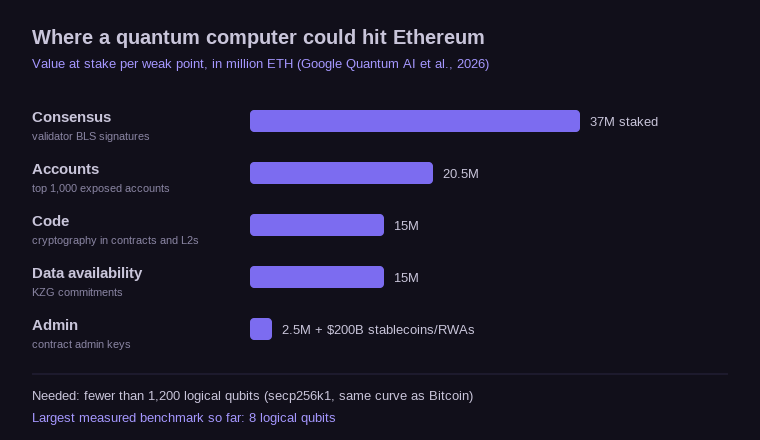
Breaking an Ethereum key takes fewer than 1,200 error-corrected "logical" qubits and fewer than 500,000 physical qubits, in minutes, according to Google Quantum AI and co-authors. That is the same number as for Bitcoin, because Ethereum signs with the same elliptic curve.
No such machine exists. What differs from Bitcoin is how much of Ethereum depends on that curve. Below: the number, the five weak points, and what Ethereum's developers plan.
Same curve, same number
Every ordinary Ethereum account has a private key and a public key. Ethereum's own documentation says: "The public key is generated from the private key using the Elliptic Curve Digital Signature Algorithm" (ethereum.org). The curve is secp256k1, the same one Bitcoin uses.
In March 2026, Google Quantum AI published new estimates with co-authors including Justin Drake of the Ethereum Foundation and Dan Boneh of Stanford. Their words: "Our findings apply directly to ECDLP on secp256k1", a curve used "on popular blockchains, such as Bitcoin and Ethereum" (Babbush et al., arXiv:2603.28846). ECDLP is the math problem behind the curve: working back from a public key to the private key.
The paper gives two designs: fewer than 1,200 logical qubits with fewer than 90 million Toffoli gates, or fewer than 1,450 logical qubits with fewer than 70 million. A Toffoli gate is one basic step of the calculation. On a superconducting machine that comes to "fewer than half a million physical qubits". A first fast machine could solve one key "in about 9 minutes on average".
A physical qubit is one piece of hardware that makes mistakes. A logical qubit is a group of physical qubits that corrects its own errors and works as one reliable qubit. How that works, and why Shor's algorithm is the attack, is in our Bitcoin qubit article.
The difference: accounts stay exposed
Your Ethereum address is not your public key. It is "the last 20 bytes of the Keccak-256 hash of the public key" (ethereum.org). A hash is a one-way fingerprint. Think of a sealed envelope with your public key inside: people can see the envelope, not the key.
The first time an account sends a transaction, the envelope opens for good. The public key is then on the blockchain. An Ethereum account is meant to be used again and again under the same address, so from then on an attacker has all the time it needs. The Google paper calls this an "at-rest" attack.
Its estimate: a quantum computer of that kind "could crack the 1,000 highest-net-worth Ethereum accounts" that had sent a transaction, holding about 20.5 million ETH at the time of writing, "in less than nine days". The Ethereum Foundation's post-quantum team adds: "Accounts that have never revealed a public key are not directly exposed" (pq.ethereum.org).
Five weak points, not one
On Bitcoin, the question is mainly about coins on addresses. Ethereum also runs validators, smart contracts and layer-2 networks, and several of those lean on elliptic curves too. The Google paper lists five weak points (table II):
| Weak point | What uses the curve · value at stake (Google paper) |
|---|---|
| Accounts | ECDSA signatures of ordinary accounts · 20.5 million ETH in the top 1,000 exposed accounts |
| Admin | Admin keys that control smart contracts · 2.5 million ETH, plus 200 billion US dollars in stablecoins and tokenized real-world assets |
| Code | Cryptography inside contracts and layer-2 networks · 15 million ETH |
| Consensus | BLS signatures of validators, the computers that stake ETH to confirm blocks · 37 million ETH staked |
| Data | KZG commitments, a mathematical fingerprint for blocks of data · 15 million ETH |
In total, the paper says, "Ethereum's aggregate economy amounts to over 600 billion USD." Dollar values move with prices; these are snapshots from spring 2026. Our older article on Ethereum's quantum escape plan covers the migration debate.
What Ethereum is doing
The Ethereum Foundation "formed a dedicated Post-Quantum Security team in January 2026" (ethereum.org). Its plan, on pq.ethereum.org, replaces the BLS signatures of validators with hash-based signatures (leanXMSS). For accounts, the team is evaluating "Falcon, Dilithium, SPHINCS+", signature schemes that resist quantum computers.
Smart accounts are part of the route: "smart accounts can upgrade signature verification logic", the team writes. A proposal for native account abstraction, EIP-8141, "is being considered for the Hegotá upgrade", which ethereum.org lists as targeted for 2027.
The Google authors are cautious about today's tools. Account abstraction via ERC-4337 and EIP-7702 helps, they write, but these "mitigate the symptoms and not the root cause".
What exists today
The best measurement of fault-tolerant computing is a benchmark by Sandia National Laboratories, with Quantinuum and NVIDIA, from September 2026. It ran error-corrected programs on up to 8 logical qubits (Proctor et al., arXiv:2609.12146). Against fewer than 1,200 needed, that is a gap of roughly 150 times. Ethereum.org puts it plainly: "No quantum computer can break Ethereum's cryptography today." Our Q-Day tracker follows the gap; for RSA, see how many qubits to break RSA-2048.
What we do not know
Whether the hardware assumptions hold. The Google estimate assumes one error per thousand operations on every physical qubit, at a scale of half a million qubits. No one has built that.
Whether the plan keeps its dates. Ethereum.org says core post-quantum milestones "target completion by approximately 2029", and adds: "These are planning targets and may shift." The team itself writes: "We do not believe a cryptographically relevant quantum computer is imminent."
How many accounts will move in time. A protocol upgrade does not move anyone's funds. Every holder still has to act, and lost keys never will.
When. None of these sources gives a date for a machine. Forecasts with dates, each with who makes it, are in the Q-Day timeline, and the Q-Day countdown runs to the earliest of them.
What this means for you
An account that has sent transactions has a public key on the blockchain. That is fine today and for as long as no large quantum computer exists. The real protection comes when Ethereum offers post-quantum accounts: moving early is then the step that counts. Follow the official ethereum.org and pq.ethereum.org pages for that, not offers of "quantum-safe" tokens. Nothing on this page is investment advice.