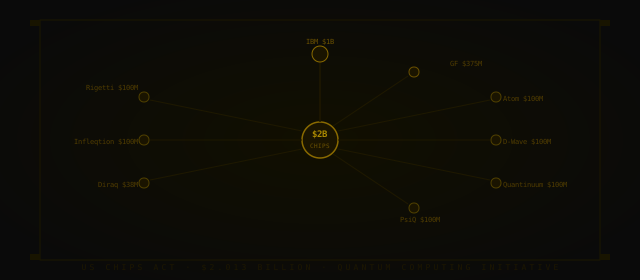
On May 21, 2026, the US Department of Commerce announced letters of intent to provide $2.013 billion in CHIPS Act incentives to nine companies working on quantum computing and quantum manufacturing. The portfolio spans four distinct quantum hardware modalities, superconducting, neutral-atom, trapped-ion, and photonic, and includes both chip foundries and full-stack quantum computer builders. It is the largest single coordinated quantum investment in US government history, and its structure reveals something important about where the race to Q-Day actually stands.
The full funding breakdown
| Company | Technology | Amount |
|---|---|---|
| IBM | Superconducting quantum foundry | $1,000M |
| GlobalFoundries | Multi-modality secure foundry | $375M |
| Atom Computing | Neutral-atom systems | $100M |
| D-Wave | Superconducting (annealing) | $100M |
| Infleqtion | Neutral-atom engineering | $100M |
| PsiQuantum | Photonic quantum computing | $100M |
| Quantinuum | Trapped-ion systems | $100M |
| Rigetti Computing | Superconducting systems | up to $100M |
| Diraq | Silicon-spin qubits | up to $38M |
Why fund nine companies across four modalities?
The portfolio approach is not indecisiveness, it is a strategic hedge. No one in the US government, or the quantum computing industry, knows which hardware approach will first produce a fault-tolerant, cryptographically relevant quantum computer. Superconducting systems (IBM, Google, Rigetti) currently lead in qubit counts and error correction milestones. Trapped-ion systems (Quantinuum) lead in qubit fidelity, the accuracy of individual gate operations. Neutral-atom systems (Atom Computing, Infleqtion) offer promising connectivity and scalability. Photonic computing (PsiQuantum) operates at room temperature, eliminating the costly cryogenic infrastructure that all other approaches require. Silicon-spin qubits (Diraq) are compatible with existing semiconductor fabrication lines.
Any one of these approaches could hit a breakthrough that leapfrogs the others. By funding all of them, the US government is ensuring that if the critical advance comes from trapped-ion systems or photonic computing, it happens on American soil and with American technology, not in a supply chain dependent on foreign components or foreign fabs.
The IBM foundry: the most significant allocation
The $1 billion allocated to IBM is not for a new quantum computer, it is to establish a quantum foundry subsidiary for superconducting wafer production. This is a structural investment in manufacturing infrastructure, not research. Superconducting quantum chips require specialized fabrication processes, ultra-low-temperature materials, and cleanrooms calibrated to tolerances far beyond standard semiconductor manufacturing. Building a dedicated domestic foundry for this means the US quantum supply chain, for superconducting processors specifically, no longer depends on repurposed semiconductor fabs or foreign materials suppliers.
The GlobalFoundries allocation ($375 million) extends this to a multi-modality secure foundry: a single facility capable of fabricating quantum chips across multiple hardware approaches. The combination of IBM's superconducting foundry and GlobalFoundries' multi-modality facility gives the US a domestic manufacturing base that no other country currently has at this scale.
What this signals for the Q-Day timeline
Government investment at this scale is not made without an underlying threat assessment. The Department of Commerce does not commit $2 billion to quantum manufacturing because quantum computing is an interesting long-term research direction. It does so because the agencies responsible for US national security, the NSA, CISA, and NIST, have concluded that the timeline to a cryptographically relevant quantum computer is short enough to require urgent industrial-scale preparation now.
That assessment is consistent with the public evidence. Google's security team targets 2029 as the planning horizon for a fully error-corrected quantum computer. The NSA's CNSA 2.0 framework sets January 2027 as the first hard deadline for quantum-safe encryption across national security systems. Three papers published between May 2025 and March 2026 have dramatically reduced the estimated qubit threshold for breaking RSA-2048. China's Origin Quantum launched a 180-qubit system in May 2026. Microsoft's Majorana 1 demonstrated a credible path to topological qubit scaling in early 2025. The $2 billion commitment reflects a government that has read these signals and concluded that falling behind in quantum hardware manufacturing is not an acceptable risk.
What it means for post-quantum migration
For organizations planning their cryptographic transition, the CHIPS Act quantum funding carries a specific message: the US government believes quantum hardware will reach cryptographic relevance within the planning horizon of organizations that are making infrastructure decisions today. The funding is designed to ensure that American companies, not foreign ones, produce that hardware first. But the encryption you are protecting with RSA or ECDSA does not become safer because the quantum computer that breaks it will be American-made.
NIST's post-quantum standards, ML-KEM, ML-DSA, FN-DSA, and SLH-DSA, are final and available. The migration window is open. The $2 billion investment is a signal that the window will not remain open indefinitely.