Cryptocurrency
Your Cold Wallet Might Already Be Compromised — And No Breach Ever Happened
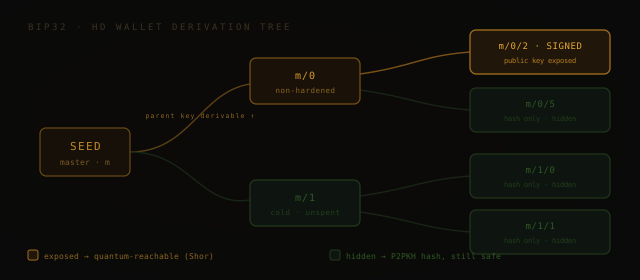
In a BIP32 wallet, one signed address can expose its public key on-chain, and through a non-hardened path, put the parent key and seed within reach of a future quantum attack, while never-spent addresses stay hidden behind a hash.
You believe your bitcoin is safe in a cold wallet. The seed has never been online. No app has ever seen the private keys. And yet that same wallet could already be exposed to a future quantum attack. The vulnerability is not a leak. It is built into the way most wallets generate their addresses.
How Bitcoin addresses are accidentally quantum safe
Every Bitcoin address you have never spent from is currently quantum safe. That is not a design feature. It is a side effect of P2PKH. Your address is a hash of the public key. As long as you do not sign a transaction, the public key stays hidden.
The moment you spend, that protection disappears. The public key is published on the blockchain and becomes visible to everyone including a future quantum computer.
The hidden line in your HD wallet
Most wallets use BIP 32: one seed that derives an entire tree of keys. Your cold savings address and your hot spending address often share the same lineage.
BIP 32 has two modes: hardened and non hardened. Non hardened is the default in most wallets. It is convenient because you can generate public keys without ever touching the private key. Ideal for watch only wallets or address generation on a server.
The rarely documented tradeoff: if the private key of a non hardened child and the public key of its parent are both known, you can calculate the parent private key. This is not a quantum problem. It is classical mathematics that already works today.
Quantum makes it worse
Shor's algorithm does not need a leaked private key. It derives the private key directly from the public key. Exactly the thing every wallet exposes the moment you sign.
The real question is not: Has my key ever been leaked? The real question is: Has any key on my derivation path ever signed a transaction?
Researchers estimate that around 7 million bitcoin currently sit on addresses with exposed public keys. Mainly through address reuse and legacy address types. At current prices, that is more than 450 billion dollars sitting on keys that a sufficiently powerful quantum computer could theoretically reach.
No one designed for this in 2012
BIP 32 was created in an era when a cryptographically relevant quantum computer still looked like science fiction. Shor's algorithm existed on paper, but the hardware did not.
Google's 2026 estimate puts the requirement to break Bitcoin's ECDSA at under 1200 logical qubits, with an attack that could run in minutes once the hardware exists.
What quantum safe by design actually means
It means the derivation tree, the signature scheme, the address format, and the entire wallet hierarchy assume from the first block that public keys will eventually become computationally reversible.
Not as a retrofit after 7 million bitcoin already have exposed keys.
What you can still do this week
Open your wallet. Check the derivation path. Which addresses were derived from a parent that has already signed a transaction?
This is not a hypothetical exercise. It is homework you can finish today.
What does your tree look like?