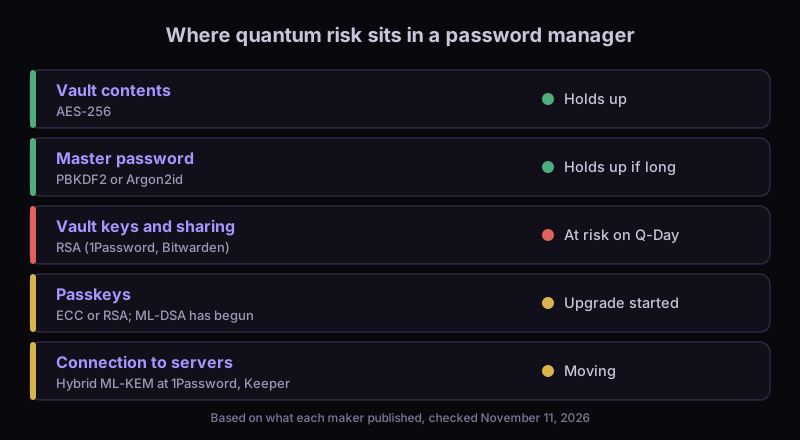
Mostly yes, for now. The vault itself is locked with AES-256, which quantum computers are not expected to break. The weak spots are the parts that use public-key cryptography: the keys that open (shared) vaults, your passkeys, and the connection to the company's servers.
Below: what each part uses, what four well-known password managers have published themselves, and what you can do today.
How a password manager locks your data
A password manager uses two kinds of encryption. Your items are locked with symmetric encryption: one secret key both locks and unlocks. 1Password uses AES with 256-bit keys in GCM mode (1Password Security Design). Bitwarden uses AES-CBC with 256-bit keys plus an HMAC check (Bitwarden Help).
The keys themselves are protected with your master password. Bitwarden stretches it with PBKDF2 at 600,000 rounds, or Argon2id if you choose it (Bitwarden Security Whitepaper). That makes every guess slow.
Then there is public-key cryptography: a key pair in which the public half locks and only the private half unlocks. That is what lets you share a vault without the company ever seeing your data. 1Password uses RSA-OAEP with 2048-bit keys, and every vault key is encrypted with your public key (1Password, How vault items are secured). Bitwarden uses RSA-OAEP for organizations and emergency access.
Think of a heavy safe whose key sits in a small lockbox with a padlock. A quantum computer is not expected to crack the safe. It could pick the padlock.
What a quantum computer can and cannot break
Shor's algorithm breaks RSA and elliptic-curve cryptography (ECC). It works out the private key from the public key. Symmetric encryption is a different story. The NSA writes that symmetric algorithms "are considered secure, provided the key size is sufficiently large," and keeps AES-256 in its quantum-resistant CNSA 2.0 suite (NSA, CNSA 2.0 FAQ).
So the contents of your vault hold up. For the master password, the old rule stays: long and unique beats everything.
The RSA layer is the risk. Someone who copies the encrypted data from a company's servers, for example after a breach, cannot read it today. If they keep it until a large quantum computer exists, they could calculate the private key from the stored public key and open the vault keys. That is harvest now, decrypt later, applied to your vault. Your password does not help here: the attacker no longer needs it.
Four password managers side by side
| Manager | What it has published (checked November 11, 2026) |
|---|---|
| 1Password | Vault AES-256-GCM; vault keys wrapped with RSA-OAEP 2048. Hybrid post-quantum connection (X25519MLKEM768) for the web app in browsers that support it, since March 31, 2026. Post-quantum passkeys (ML-DSA) since version 8.12.44, October 20, 2026 (1Password blog; 1Password blog) |
| Bitwarden | Vault AES-CBC 256 with HMAC; RSA-OAEP for organizations and emergency access. Bitwarden says it "is currently investigating post-quantum cryptography options" (Bitwarden Help) |
| Keeper | Hybrid Kyber plus elliptic-curve encryption for traffic between your device and Keeper's servers, in all vault clients and infrastructure. It does not say whether sharing keys are covered (Keeper) |
| Dashlane | A working post-quantum sharing mechanism between its Android app and web extension, not yet rolled out to customers. No date given; last update December 2023 (Dashlane blog) |
Note what the post-quantum work covers. 1Password and Keeper protect the connection first. That matters, but the data that travels is already encrypted by the vault. 1Password calls its step "the first phase of a broader post-quantum roadmap." None of the four says it has replaced the RSA layer that wraps vault keys.
Passkeys: new, and public-key
A passkey is a key pair. The website stores your public key; your password manager keeps the private key. The web standard behind passkeys, WebAuthn Level 3, shows sites accepting EdDSA, ES256 or RS256 keys: elliptic curves or RSA (W3C WebAuthn Level 3). A large quantum computer could calculate your private key from the public key the site holds.
There is one difference with your vault. A stolen passkey only helps an attacker once such a computer exists. It does not open old recordings. The damage is someone logging in as you, not reading your past.
1Password started on this on October 20, 2026. From version 8.12.44 it creates passkeys with ML-DSA, the signature algorithm NIST standardized in 2024, but only for websites that support it. Creating one is not yet possible on iOS or through the native macOS autofill. 1Password says existing passkeys are still safe because no such quantum computer exists yet, and that it is working with the W3C and the FIDO Alliance on a way to upgrade them (1Password blog).
What we do not know
When the RSA layer goes. 1Password and Bitwarden have not said when vault keys will be wrapped with a post-quantum algorithm.
How far Keeper's protection reaches. Keeper describes client-server traffic, not sharing between users.
Other managers. We did not check Apple Passwords, Google Password Manager, LastPass or Proton Pass for this article.
When a quantum computer can do this. Forecasts differ, and each has a name attached. Our Q-Day timeline lists them, and the Q-Day countdown runs to the earliest.
What this means for you
There is no reason to switch managers in a hurry. Use a long, unique master password, turn on two-factor login, and keep your apps and browser updated: the post-quantum connection only works when both sides support it.
The good news is that most passwords can be changed. A password copied today is worthless on Q-Day if you have changed it by then. Recordings of medical files cannot be changed; your bank password can. Be more careful with secrets that stay valid for many years, such as recovery codes, private keys or documents in a shared vault. Our Mosca's theorem calculator helps you judge how long "many years" is. For apps you chat with, see which messaging apps are quantum-safe.