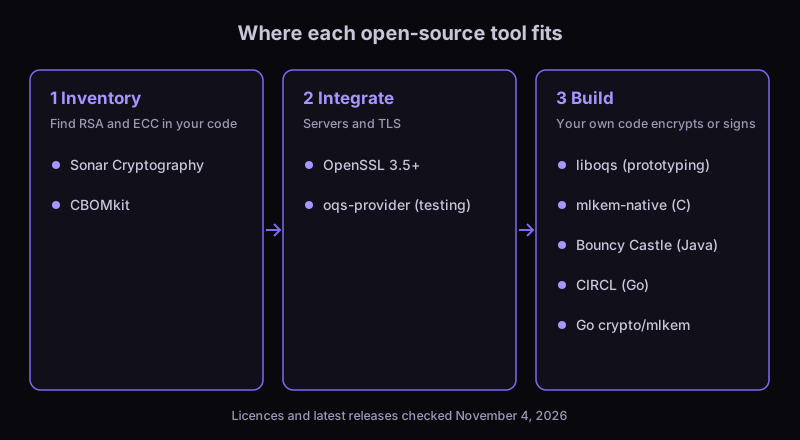
The best open-source tool to start with post-quantum cryptography is usually one you already have: OpenSSL 3.5 or newer, which ships the new NIST algorithms. After that you need a scanner that shows where your code still uses RSA and elliptic curves, and a maintained library for your programming language.
Below are nine tools in three groups. For each one: what it does in one sentence, its licence, its latest release and who it is for. We checked every entry on November 4, 2026, on the project's own page. Versions change, so check the source link before you rely on a number.
Three terms first
Post-quantum cryptography is ordinary software that uses math a quantum computer is not known to break. It replaces RSA and elliptic-curve cryptography (ECC), which a large quantum computer running Shor's algorithm could break. ML-KEM is the NIST standard for agreeing on a secret key (FIPS 203). ML-DSA and SLH-DSA are the NIST standards for digital signatures. A hybrid key exchange combines a classical method with ML-KEM, so an attacker has to break both.
Think of the migration as changing the locks in a large building. First you walk every corridor and list each lock (inventory). Then you check which locks the building manager's standard kit already covers (OpenSSL). Only then do you order special locks for the doors that need them (libraries). For the full picture, see our explainer on post-quantum cryptography.
Inventory: find where you still use RSA and ECC
You cannot replace what you have not found. A CBOM (cryptography bill of materials) is a list of every algorithm, key and certificate your software uses. Both tools below come from the CBOMkit project and write that list in the open CycloneDX format.
| Tool | What it does |
|---|---|
| Sonar Cryptography | A SonarQube plugin that finds cryptography in source code and writes a CBOM. Licence: Apache-2.0. Latest release: 1.7.0 (September 1, 2026). For: teams that already run SonarQube. (GitHub) |
| CBOMkit | A toolset that generates CBOMs from git repositories, shows them in a viewer and checks them against a policy. Licence: Apache-2.0. Latest release: 2.3.0 (September 9, 2026). For: security teams making an inventory. (GitHub) |
An inventory is also the first step in our Y2Q migration guide and in how to prepare for Q-Day.
Integration: servers and TLS
TLS is the encryption behind HTTPS. On most servers it is handled by OpenSSL, not by your application code. That makes OpenSSL the cheapest place to start.
| Tool | What it does |
|---|---|
| OpenSSL 3.5+ | The crypto library behind most web servers. Version 3.5.0 (April 8, 2025) added ML-KEM, ML-DSA and SLH-DSA, and offers the hybrid key exchange X25519MLKEM768 in TLS by default. Licence: Apache-2.0. Latest release: 4.1.0 (October 23, 2026); on the 3.5 line, 3.5.9 (September 29, 2026). For: server administrators. (release notes) |
| oqs-provider | Plugs liboqs into OpenSSL 3, so you can test algorithms OpenSSL does not ship itself. Its README says not to rely on it in production. Licence: MIT. Latest release: 0.12.0 (October 8, 2026). For: testing and research. (GitHub) |
To check your server, run openssl version. Our PHP article shows what that means for a typical web stack.
Libraries: when your own code encrypts or signs
You need a library only if your own code encrypts, exchanges keys or signs, outside TLS. Pick one that is maintained for your language.
| Tool | What it does |
|---|---|
| liboqs | A C library with many post-quantum algorithms behind one interface, from the Open Quantum Safe project. Its README says it is meant for research and prototyping, not for production or sensitive data. Licence: MIT (some bundled parts carry their own licence). Latest release: 0.16.0 (July 9, 2026). For: prototyping and comparing algorithms. (GitHub) |
| mlkem-native | A portable C implementation of ML-KEM only. Its authors prove most of the C code memory-safe and the Arm and x86 assembly correct and constant-time (no timing leaks), with formal tools. Licence: Apache-2.0, ISC or MIT, your choice. Latest release: v2.0.0 (August 7, 2026). For: C developers who need ML-KEM. (GitHub) |
| Bouncy Castle | A widely used Java crypto library. ML-KEM, ML-DSA and SLH-DSA since version 1.79 (October 31, 2024). Licence: MIT. Latest release: 1.86 (September 11, 2026). For: Java developers. (Bouncy Castle) |
| CIRCL | Cloudflare's Go library with ML-KEM, ML-DSA and more. Cloudflare warns that part of it is experimental. Licence: BSD-3-Clause. Latest release: v1.6.5 (August 5, 2026). For: Go developers who need more than the standard library. (GitHub) |
| Go crypto/mlkem | Part of Go's standard library since Go 1.24 (February 2025), with ML-KEM-768 and ML-KEM-1024. Nothing extra to install. Licence: BSD-3-Clause. Latest Go release: 1.27.3 (October 19, 2026). For: Go developers. (Go 1.24 release notes) |
Retired
PQClean, a collection of clean C implementations that many lists still mention, is retired and archived as read-only. Its own page points to mlkem-native and liboqs instead (PQClean on GitHub).
Which tool for whom
Server or IT administrator: check your OpenSSL version and plan the upgrade to 3.5 or newer. Developer: use what your platform already offers (Go's standard library, Bouncy Castle on Java, mlkem-native in C) and keep liboqs for experiments. Security team: start with a CBOM, because every deadline asks for an inventory first.
Those deadlines are real. NIST's transition guidance marks quantum-vulnerable public-key algorithms as deprecated after 2030 and disallowed after 2035 (NIST IR 8547). See post-quantum deadlines for who has to act when.
How we chose
Open source, maintained, with a release or commit in 2026, and used beyond a single author. We left out small personal projects without users or audits, even when they look useful. No project paid to be listed, and there are no affiliate links. A tool is missing that should be here? Use the contact link at the bottom of the page.
What we do not know
How secure each implementation is. mlkem-native publishes formal proofs; liboqs, oqs-provider and CIRCL themselves warn against production use or call parts experimental. We have not audited any of them.
How long these versions stay current. This page shows the state on November 4, 2026. Always check the source link.
When Q-Day comes. Forecasts differ and each has a name attached. The countdown page lists the sources.