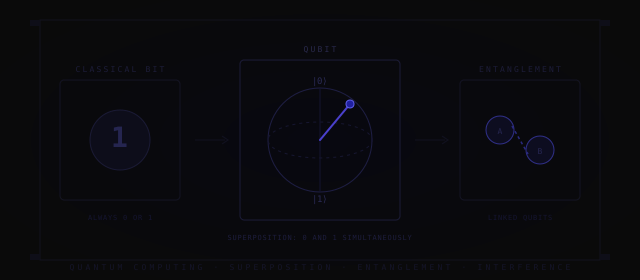
Quantum computers are regularly described as revolutionary, machines that will one day break encryption, simulate molecules, and solve problems that would take classical supercomputers the age of the universe to crack. But the question most articles skip is the most basic one: how do they actually work? What makes a quantum computer fundamentally different from the laptop you are reading this on? The answer comes down to three quantum mechanical properties: superposition, entanglement, and interference.
Start with the bit, then break it
Every classical computer, from a 1970s pocket calculator to a modern data centre, processes information as bits. A bit is a physical thing: a transistor that is either on or off, a magnetic domain pointing either up or down. Every bit has exactly one value at any given moment: 0 or 1. A string of 8 bits can hold exactly one of 256 possible values. A string of 64 bits can hold exactly one of roughly 18 quintillion possible values, but at any moment, it holds only one.
A quantum computer replaces bits with qubits (quantum bits). A qubit is also a physical thing, a single electron, a photon, an ion, or a tiny superconducting circuit, but it obeys quantum mechanical rules rather than classical ones. The critical difference: before you measure it, a qubit does not have to be 0 or 1. It can be in a superposition of both 0 and 1 simultaneously.
Superposition: holding all possibilities at once
Superposition is not a vague metaphor, it is a precise mathematical description of a quantum state. A qubit in superposition is simultaneously 0 and 1, with a probability amplitude assigned to each. When you measure it, the superposition collapses to a definite value, but until you measure it, both possibilities exist at once.
This is where the power starts to emerge. Two qubits in superposition represent four states simultaneously: 00, 01, 10, and 11. Three qubits represent 8 states. Ten qubits represent 1,024 states. Fifty qubits represent over a quadrillion states, more than can be stored in any classical memory. A quantum computer with n qubits in superposition operates on 2ⁿ states simultaneously. That exponential scaling is why quantum computing is fundamentally different, not merely faster.
300 qubits in superposition can represent more states simultaneously than there are atoms in the observable universe. The computational space accessible to a quantum computer grows exponentially with each qubit added, classical computers grow linearly.
Entanglement: linking qubits across space
The second key property is entanglement. Two qubits can be placed in an entangled state, a joint quantum state in which the result of measuring one qubit instantly determines the state of the other, regardless of the physical distance between them. Einstein famously called this "spooky action at a distance" and was deeply uncomfortable with it. Experiment after experiment over the past decades has confirmed: entanglement is real.
In a quantum computer, entanglement is not primarily used for communication, it is used to create correlations between qubits that allow computations to propagate through the entire system at once. When you entangle many qubits together and perform operations on them, the computation is not happening on one state at a time, it is happening across all 2ⁿ possible states simultaneously. The entangled system behaves as a single quantum object, not as a collection of independent bits.
Interference: amplifying right answers, cancelling wrong ones
Here is the part most explanations skip, and it is the most important: superposition alone does not give you the answer. If you just measured a superposition of all possible states, you would get a random result. The power of quantum computing comes from the third property: interference.
Quantum states have phases, like waves of light or sound, they can be in phase with each other (constructive interference, amplifying) or out of phase (destructive interference, cancelling). A quantum algorithm is a carefully designed sequence of quantum gates that manipulates these phases so that the probability amplitudes of wrong answers cancel each other out, while the probability amplitude of the correct answer is amplified. When you finally measure the system, you are overwhelmingly likely to observe the right answer, not because the computer tried every option one at a time, but because the quantum wave function was steered to collapse on the solution.
This is what makes a quantum algorithm fundamentally different from brute-force search. Classical brute force checks one state at a time. A quantum algorithm sets up a superposition across all states simultaneously, then uses interference to guide the system toward the answer in a fraction of the steps.
Why quantum computers are not just faster classical computers
A common misconception is that quantum computers are simply classical computers running faster. They are not, and this distinction matters enormously. A quantum computer is not better at everything. It is exponentially better at a specific class of problems: those where the answer can be verified efficiently and interference can be used to steer toward it. Factoring large numbers (Shor's algorithm), searching unsorted databases (Grover's algorithm), and simulating quantum systems are in this class. General-purpose computing tasks, running a web browser, rendering a video, writing a spreadsheet, are not. A quantum computer would be no faster than a classical machine for most everyday tasks.
The specific problems that quantum computers excel at happen to include the mathematical foundations of most modern cryptography. RSA encryption is secure because factoring a 2048-bit number into its prime components would take a classical supercomputer longer than the age of the universe. A sufficiently large quantum computer running Shor's algorithm could do the same factoring in hours. That is the direct line between the physics of qubits and the concept of Q-Day. For a deeper comparison of both architectures, see Quantum vs Classical Computing: What's Actually Different?
Why building a useful quantum computer is so hard
If qubits are so powerful, why do we not already have a machine capable of breaking RSA? Because maintaining a useful quantum state is extraordinarily difficult. Qubits are fragile, any interaction with the environment (heat, vibration, electromagnetic noise, even cosmic rays) can cause decoherence: the quantum state collapses prematurely and the computation is lost. Today's most advanced quantum processors, including Google's 105-qubit Willow chip and IBM's multi-chip systems, operate at temperatures colder than outer space, around 15 millikelvin, specifically to minimize thermal noise.
Even then, every quantum gate operation introduces errors. The field of quantum error correction addresses this by encoding each logical qubit across many physical qubits, using redundancy to detect and correct errors before they propagate. Running Shor's algorithm against RSA-2048 requires millions of physical qubits performing error-corrected operations, a threshold no current machine approaches, but one that hardware trajectories suggest is reachable within this decade. See expert estimates for when RSA-2048 will fall. That is why the timeline to Y2Q is measured in years, not generations.