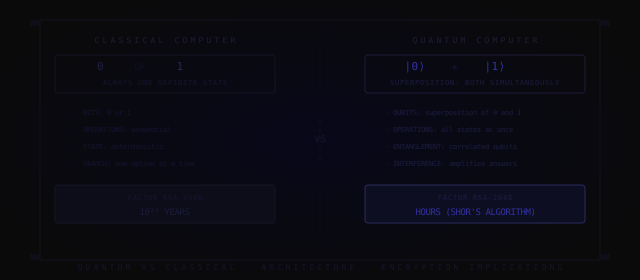
There is a persistent misconception embedded in nearly every mainstream description of quantum computing: that quantum computers are classical computers running faster. They are not. The difference is architectural, not quantitative, and understanding it is the key to understanding both why quantum computers threaten Q-Day and why they will never replace the machine you are reading this on.
How classical computers process information
All classical computers, from embedded microcontrollers to the world's largest supercomputers, share the same fundamental design. They process information as bits: physical switches that are either on (1) or off (0). Every operation transforms one set of bit states into another. A 64-bit processor can represent any one of roughly 18 quintillion distinct values, but at any given moment, it holds exactly one of them.
This architecture is deterministic: given the same input and the same program, a classical computer always produces the same output. To search through N possible answers, a classical computer checks them one at a time. The best classical factoring algorithm, the General Number Field Sieve, runs in sub-exponential but still enormous time. For RSA-2048, it would require more computation than the age of the universe on any classical machine.
How quantum computers process information
A quantum computer replaces bits with qubits, physical systems (superconducting circuits, trapped ions, photons) that obey quantum mechanical rules. Three properties distinguish them from classical bits:
Superposition. A qubit can exist in a combination of 0 and 1 simultaneously, with a probability amplitude assigned to each state. Two qubits in superposition represent 4 states simultaneously; ten qubits represent 1,024; fifty represent over a quadrillion. The computational space accessible to a quantum computer grows exponentially with each qubit added, a classical computer grows linearly.
Entanglement. Qubits can be correlated in ways with no classical equivalent. When two qubits are entangled, measuring one instantly determines the state of its partner. In a quantum computer, entanglement creates correlations between qubits that allow computations to propagate through the entire system simultaneously.
Interference. Quantum states have phases, like waves, they can constructively or destructively interfere. A quantum algorithm is designed so that wrong answers cancel out while the correct answer is amplified. When you measure the system at the end, you are overwhelmingly likely to observe the right answer, not because the machine tried every option sequentially, but because the quantum wave function was steered toward the solution. This is what makes quantum computing fundamentally different from brute force.
What quantum computers are, and are not, better at
Quantum computers are not universally faster. They offer exponential advantages only for a specific class of problems where superposition and interference can be exploited. Outside that class, they provide no advantage, and in many cases perform worse than classical hardware.
| Problem | Classical | Quantum |
|---|---|---|
| Factor RSA-2048 | Longer than age of universe | Hours (Shor's algorithm) |
| Search unsorted database | O(N), check each entry | O(√N), Grover's algorithm |
| Simulate molecules | Exponentially hard | Exponential speedup |
| Run a web browser | Fast | No speedup, not applicable |
| Process spreadsheets | Fast | No speedup, not applicable |
| Break AES-256 symmetric | Secure | Halved security (AES-128 equivalent), still secure |
A quantum computer running Shor's algorithm can factor RSA-2048 in hours. The same machine cannot run your operating system faster than the laptop sitting next to it. These are fundamentally different machines for different purposes, not the same machine on a different power setting.
Why decoherence makes quantum hardware so difficult
Maintaining a useful quantum state is extraordinarily hard. Any interaction with the environment, heat, vibration, electromagnetic noise, even cosmic rays, causes decoherence: the quantum state collapses prematurely and the computation fails. Today's most advanced quantum processors operate near absolute zero (roughly 15 millikelvin, colder than outer space) specifically to minimize thermal noise.
Even then, every gate operation introduces errors. Quantum error correction addresses this by encoding each logical qubit across many physical qubits, using redundancy to detect and correct errors before they propagate. This overhead is the reason why a machine capable of breaking RSA-2048 requires millions of physical qubits, even though the computation itself requires only thousands of logical ones. Current hardware, at the 100–1,000 physical qubit scale, cannot run Shor's algorithm at the required scale. But the trajectory of hardware development makes million-qubit machines plausible within this decade.
The specific threat to encryption
The architectural gap explains both why quantum computers are dangerous to RSA and why that danger is specific. RSA and elliptic curve cryptography (ECC) rely on mathematical problems, integer factoring and discrete logarithms, that are easy to compute forward but hard to reverse classically. Shor's algorithm exploits superposition and the Quantum Fourier Transform to reverse these problems in polynomial time, an exponential speedup over the best classical approach.
AES-256 symmetric encryption is different. Grover's algorithm can search for an AES key quadratically faster than classical brute force, but quadratic, not exponential. That halves the effective key length, making AES-256 equivalent to roughly AES-128 against a quantum adversary. AES-128 is still considered secure. This is why post-quantum cryptography standards (ML-KEM, ML-DSA, SLH-DSA) are designed to replace RSA and ECC specifically, not symmetric encryption.
The quantum threat to encryption is real and urgent. It is also precise. Understanding which algorithms break under quantum attack, and which do not, is the difference between informed migration planning and blanket panic. The harvest now, decrypt later strategy already in use by state actors means that RSA-encrypted data with long-term sensitivity is exposed to this risk today, regardless of when a cryptographically relevant quantum computer is actually built.