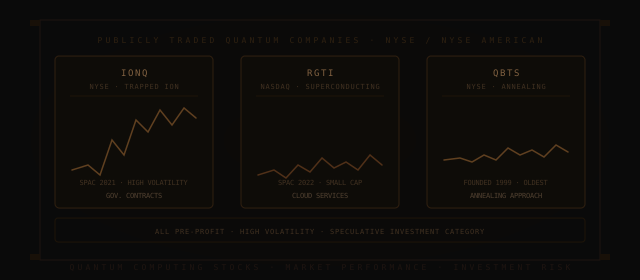
Since 2021, a small group of quantum computing companies have traded on public stock exchanges, giving retail and institutional investors their first direct exposure to the sector without going through venture capital. The three most prominent, IonQ, Rigetti Computing, and D-Wave Quantum, arrived on the market through special purpose acquisition company (SPAC) mergers, a route that allows pre-revenue technology companies to go public without the traditional IPO process. Their story since then is a case study in the gap between technological ambition and financial reality.
Understanding these companies requires separating two distinct questions: whether quantum computing will eventually transform industry, which most experts believe it will, and whether these specific publicly traded companies represent good investments at any given valuation. The two questions have very different answers.
IonQ (IONQ), NYSE
Investors: Hyundai, Goldman Sachs, US Air Force Research Lab
IonQ is the most prominently traded pure-play quantum computing stock and the one with the clearest near-term commercial activity. The company uses trapped-ion qubits, individual charged atoms suspended in electromagnetic fields, which have historically delivered higher gate fidelity than competing superconducting approaches, at the cost of slower operation speed. IonQ went public in October 2021 via SPAC at an implied valuation of around $2 billion and has seen extreme volatility since, driven by news flow around government contracts (including with the US Air Force Research Laboratory), research partnerships, and broader sentiment toward speculative technology stocks. IonQ has partnered with Hyundai Motor on quantum-assisted EV battery chemistry research and with Goldman Sachs on financial optimization applications, relationships that signal how enterprise customers are beginning to explore near-term quantum utility, even before full fault tolerance is achieved. The company reports growing revenue from cloud access and professional services, though it remains deeply pre-profit and funds operations through equity issuance.
Rigetti Computing (RGTI), Nasdaq
Vertically integrated: designs and manufactures its own chips
Rigetti is one of the oldest pure-play quantum hardware companies, founded by Chad Rigetti after leaving IBM's quantum research team. The company has a vertically integrated model, unlike IonQ, which focuses on system design, Rigetti operates its own semiconductor fabrication facility (Fab-1) for superconducting quantum chips. This manufacturing capability is a potential long-term advantage but has required enormous capital investment. Rigetti went public in March 2022 via SPAC at a lower implied valuation than IonQ and has faced more acute financial pressure, including staff reductions. Its smaller market capitalization means the stock is more sensitive to individual contract announcements and technical milestones. Rigetti's approach is compatible with existing semiconductor manufacturing knowledge, which may matter as the industry scales, but in the current phase, the company is competing for revenue in a market where IBM and Google's internal quantum systems provide similar capabilities at no direct cost to customers.
D-Wave Quantum (QBTS), NYSE American
Oldest quantum computing company · Most commercially deployed systems
D-Wave is categorically different from IonQ and Rigetti, and this distinction matters enormously for investors. D-Wave's quantum computers use quantum annealing, a technique suited for optimization problems, rather than the gate-based, universal quantum computing approach that underlies Shor's algorithm and most research into fault-tolerant computation. This means D-Wave's systems do not run the same algorithms as Google's or IBM's quantum computers and are not on a path toward breaking RSA encryption. What they can do is solve certain optimization problems (logistics routing, scheduling, financial portfolio balancing) faster than classical alternatives, giving D-Wave a near-term commercial advantage in specific industrial applications. D-Wave has the most commercially deployed quantum systems of any company and generates real revenue from enterprise customers including Volkswagen, Mastercard, and various government agencies. It went public in 2022 via SPAC. Its valuation reflects its status as the closest thing to a profitable quantum company, but its technical approach is considered a specialized branch rather than the main line of development toward universal fault-tolerant quantum computation.
Why SPAC listings and extreme volatility go together
All three companies used SPAC mergers to reach public markets rather than traditional IPOs. The SPAC route allows companies to go public without the due diligence timeline of a conventional IPO, and without the requirement to demonstrate a clear path to profitability before listing. This has historically led to post-listing underperformance: the projections presented in SPAC disclosure documents often prove optimistic, and retail investors who buy in at listing prices frequently hold through significant drawdowns.
For quantum computing stocks specifically, volatility is amplified by two additional factors. First, the sector has no conventional valuation metrics, these companies are priced on expectations of future capabilities, not present earnings or even present revenue ratios. Second, quantum computing generates consistent news flow (hardware milestones, government contracts, research publications) that moves stock prices regardless of whether the news materially changes the fundamental business trajectory.
Traditional equity valuation anchors, price-to-earnings, price-to-sales, free cash flow, do not apply to pre-profit quantum companies. Valuations are effectively bets on two variables: whether the company's technical approach will work at scale, and whether the company will survive financially long enough to reach that point. Both are genuinely uncertain.
What the stocks actually reveal about the sector
The existence and trading behavior of quantum computing stocks tells us something more useful than their current prices: it tells us that institutional capital has decided quantum computing is an investable category, that governments and large enterprises are signing commercial contracts with quantum companies (legitimizing near-term revenue), and that the technology has progressed enough from pure research to attract financial markets. None of this tells you whether IonQ's stock will be higher in twelve months. But it does confirm that the question of when quantum computing becomes commercially significant is being priced in real time by markets with genuine information advantages.
Investment risk disclosure
All publicly traded quantum computing stocks are highly speculative, pre-profit investments with extreme price volatility. This article is informational and does not constitute investment advice. The quantum computing sector carries specific risks including technology obsolescence, hardware approach selection risk, and the capital intensity of operating at the research frontier. Anyone considering investment in this sector should consult a qualified financial adviser and conduct independent due diligence.