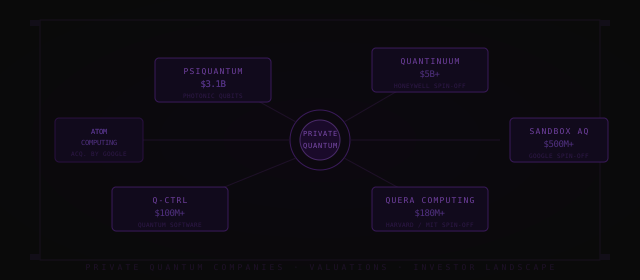
While the public debate around quantum computing focuses on qubits and timelines, a parallel story is unfolding in private capital markets. Venture capital firms, sovereign wealth funds, and the world's largest financial institutions are placing multi-hundred-million-dollar bets on quantum computing companies, most of which have no commercial revenue at scale, no profitable operations, and no guarantee their hardware approach will win. The investment logic is straightforward: if Q-Day arrives and you are not in the market, the cost of catching up will be prohibitive. The strategic stakes are simply too high to sit out.
The result is a private quantum ecosystem valued collectively in the tens of billions, anchored by a handful of well-funded companies racing to achieve fault-tolerant quantum computation first. Understanding who they are, who backs them, and what differentiates their technical approaches is increasingly relevant not just for investors, but for anyone tracking the timeline to RSA-2048 falling.
PsiQuantum: The photonic bet backed by Wall Street
PsiQuantum
$3.1 billion
PsiQuantum's central argument is that photonic qubits, quantum states encoded in particles of light, can be manufactured at scale using existing semiconductor fabrication infrastructure. While superconducting and trapped-ion approaches require exotic cryogenic hardware built in small quantities, PsiQuantum is partnered with GlobalFoundries to fabricate photonic chips using modified standard semiconductor processes. The company has raised over $700 million, with investors including Goldman Sachs, BlackRock, and Microsoft's M12 venture fund. Government backing adds further weight: Australia committed AUD $940 million to host PsiQuantum's first utility-scale machine, and the UK government has also signed partnership agreements. The bet is not just on the technology but on the manufacturing moat: if photonic qubits can be mass-produced in fabs, PsiQuantum could scale faster than any cryogenic competitor.
Quantinuum: The Honeywell spinoff with JPMorgan's backing
Quantinuum
$5 billion+
Quantinuum was formed in 2021 through the merger of Honeywell Quantum Solutions, the quantum computing division of the industrial giant, and Cambridge Quantum, a UK-based quantum software firm. Honeywell retains a majority stake, giving Quantinuum an unusual advantage: access to Honeywell's precision engineering capabilities, which matter enormously for trapped-ion hardware. In 2023, JPMorgan Chase invested $300 million in Quantinuum, valuing the company at over $5 billion and signalling that major financial institutions see quantum computing as strategically essential to their own operations. Quantinuum's H-Series quantum computers have consistently posted leading benchmark results for quantum volume, a measure of overall computational quality, and the company also sells software tools, including the TKET quantum circuit compiler, giving it a revenue stream independent of hardware.
Sandbox AQ: Quantum software, spun out of Google
Sandbox AQ
$500 million+ raised
Sandbox AQ separated from Alphabet (Google's parent) in 2022 as an independent company focused on the intersection of AI and quantum technologies. Unlike hardware-focused peers, Sandbox AQ's near-term commercial offerings are primarily in post-quantum cryptography and quantum sensing, areas where revenue is achievable now, before fault-tolerant quantum computers exist. The company has raised over $500 million from investors including Marc Benioff (Salesforce founder), Breyer Capital, and T. Rowe Price. Its post-quantum security products, assessing and migrating cryptographic infrastructure, are directly relevant to the Y2Q migration challenge facing enterprises, giving it a business model that scales with the urgency of the Q-Day threat rather than waiting for hardware maturity.
QuEra Computing: The neutral-atom challenger
QuEra Computing
$180 million+ raised
QuEra emerged from research groups at Harvard and MIT developing neutral-atom quantum computing, an approach that uses arrays of individual atoms, held in place by lasers, as qubits. Neutral atoms have a key advantage: they can be reconfigured mid-computation, allowing more flexible quantum circuits. QuEra has Google as a strategic investor and in 2025 delivered a neutral-atom quantum machine to Japan's National Institute of Advanced Industrial Science and Technology (AIST), with plans to make similar systems available to global research customers in 2026. The company's Aquila system, available via Amazon Web Services Braket, was the first neutral-atom quantum computer commercially accessible in the cloud.
What the investment thesis actually says
The common thread across all major private quantum investments is not a bet that any single company will win, it is a bet that the sector will produce at least one commercially viable fault-tolerant quantum computer within this decade, and that being positioned in the ecosystem now is worth the cost of uncertainty. JPMorgan's investment in Quantinuum, Goldman Sachs and BlackRock in PsiQuantum, and Google's backing of QuEra are not speculative wagers by risk-tolerant venture funds, they are hedging moves by institutions whose own security and competitive advantage depend on not being caught flat-footed when Shor's algorithm becomes practical.
McKinsey & Company projected in 2023 that quantum computing could generate between $450 billion and $850 billion in value by 2040, across sectors including pharmaceuticals (molecular simulation), finance (portfolio optimization), logistics (routing), and materials science. That forecast is the context in which billion-dollar private valuations make sense, even for companies with no profitable operations today.
The risk is real: quantum hardware approaches are technically diverse and it is not yet clear which will scale most effectively to fault-tolerant computation. A company backed at a $3 billion valuation could fail to achieve the engineering milestones that justify that price. But for institutional investors with multi-decade horizons, the cost of being absent from the quantum ecosystem when it matures is viewed as greater than the cost of being wrong about which company wins.