While publicly traded quantum startups attract retail investor attention, the largest investments in quantum computing are not made by venture capitalists or SPAC sponsors, they are made by the world's biggest technology companies, quietly and continuously, through internal research and development budgets that dwarf anything the startup ecosystem can deploy. IBM, Google, Microsoft, and Amazon have collectively invested tens of billions in quantum computing over the past decade. None of them have disclosed a single unified figure. All of them believe this investment is strategically necessary. Understanding why, and what they are each building, is essential context for anyone following the commercial development of quantum technology.
For IBM and Google, quantum computing is not a separate business, it is an extension of their core identity as the world's leading computing platforms. For Microsoft, it is a bet on the next generation of Azure services. For Amazon, it is a cloud access play and a hedge against competitors moving first. All four companies have concluded that a world in which quantum computing is commercially viable is a world where not being a quantum computing provider is an existential risk to their platform businesses.
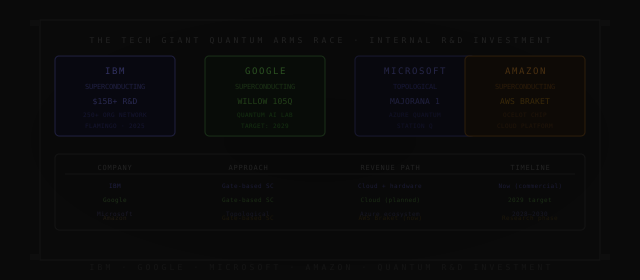
IBM has the longest corporate history in quantum computing of any tech giant. The company launched IBM Quantum Experience, the first cloud-accessible quantum computer, in 2016, a full two years before the sector began attracting serious investment. Since then, it has built a 250+ member IBM Quantum Network of companies, universities, and research institutions, making it the de facto infrastructure provider for quantum computing research globally. IBM's Flamingo-class systems, deployed across its quantum data centers in 2025, represent the current frontier of its commercial quantum hardware. IBM's quantum roadmap is the most publicly detailed of any company: the firm has consistently published multi-year hardware targets and, more importantly, has consistently met them. The strategic model is clear, IBM intends to monetize quantum through its hybrid cloud platform, positioning quantum processors as accelerators alongside classical computing resources in enterprise IBM Cloud deployments, much as GPUs became accelerators for AI workloads.
Google Quantum AI has operated since 2012 and has been responsible for some of the most significant experimental milestones in the field: the 2019 quantum supremacy demonstration with the 53-qubit Sycamore processor, and the December 2024 unveiling of the Willow chip, a 105-qubit processor that demonstrated exponential error reduction as qubit count scaled. Willow was the first system to cross the "below threshold" milestone at a scale meaningful for future fault-tolerant computation. Google's stated internal security planning deadline is 2029: the company's own security team has concluded that a cryptographically relevant quantum computer could exist by that date, and has structured its migration to post-quantum cryptography accordingly. Google's quantum investment is primarily strategic, it does not currently generate revenue directly. But the commercial roadmap involves offering fault-tolerant quantum computing as a cloud service via Google Cloud, targeting pharmaceutical companies for drug discovery and financial institutions for optimization.
Microsoft has taken the most differentiated technical bet of any major company: rather than competing on superconducting qubits alongside IBM and Google, it has spent over a decade developing topological qubits, a fundamentally different physical implementation that, in theory, offers dramatically lower error rates by encoding quantum information in a more stable physical substrate. The Majorana 1 chip, unveiled in early 2025, represented the first tangible hardware output of this research program. Microsoft's argument is that if topological qubits deliver on their theoretical promise, the overhead required for error correction could be orders of magnitude lower than for superconducting or trapped-ion approaches, meaning a fault-tolerant machine could be built with far fewer physical qubits. This remains unproven at scale, but if successful it would give Microsoft a decisive architectural advantage. In the interim, Microsoft monetizes quantum through Azure Quantum, a cloud platform that provides access to partner hardware from IonQ, Rigetti, and Quantinuum alongside quantum-inspired optimization software. Azure Quantum generates real revenue today while the topological hardware matures.
Amazon's quantum strategy is the most explicitly cloud-platform-oriented of the four giants. AWS Braket, launched in 2019, provides pay-per-use access to quantum hardware from IonQ, Rigetti, D-Wave, and Quantinuum alongside classical quantum simulation tools, allowing enterprise customers to experiment with quantum algorithms without owning or operating hardware. Amazon's internal research goes further: the Ocelot chip, announced in early 2025, is an internal superconducting quantum processor specifically designed to demonstrate progress on error correction. Amazon's approach is notable for its pragmatism, rather than betting the company on a single hardware approach, it provides access to multiple vendor systems while investing in its own error correction research. The Amazon Quantum Solutions Lab offers professional services to enterprises integrating quantum computing into business operations.
The competitive logic: why all four are in this race
The four companies have very different technical approaches but identical strategic logic. Cloud computing became a multi-trillion-dollar market because every major enterprise computation eventually migrated to the cloud. If quantum computing follows a similar trajectory, which every credible forecast suggests it will, for specific high-value problem classes, then not being a quantum cloud provider when that transition occurs is strategically catastrophic for a platform business.
IBM, Google, Microsoft, and Amazon all have platform businesses whose value depends on being the computational infrastructure that enterprises rely on. Each of them has concluded independently that they cannot allow a competitor to own the quantum layer of that stack. The investment is therefore not primarily a bet that quantum computing will happen, it is insurance against the possibility that it happens and they are not there.
The secondary motivation is the encryption threat. Google's 2029 internal planning deadline for Q-Day is not just a cryptographic migration target, it is a competitive signal. Any company that successfully builds a cryptographically relevant quantum computer will have the most powerful intelligence-gathering capability in history, and will have demonstrated the engineering depth to lead the quantum computing industry. The stakes of this race are not measured only in cloud revenue.
What this means for the broader investment landscape
The participation of IBM, Google, Microsoft, and Amazon in quantum computing fundamentally changes the risk profile of the sector for all other investors. When the world's four most capitalized technology companies decide independently that quantum computing warrants multi-billion-dollar R&D commitments, they provide a strong signal that the technology is real, that the commercial opportunity is credible, and that the timeline is measured in years rather than decades. Their participation also creates an ecosystem effect: IBM's Quantum Network creates customer relationships; Google's research publications accelerate the field's knowledge base; Microsoft's Azure Quantum platform incubates commercial use cases; Amazon's Braket lowers the barrier to experimentation. This ecosystem development is what makes the private unicorn investments and the public market valuations of IonQ, Rigetti, and D-Wave at least plausible, even if specific company bets remain highly speculative.